 French
  English
  German
  Japanese
  Arabic
  Czech
Czech  Spanish
  Korean
  Italian
  Danish
  Polish
  Turkish
  Portuguese
  Russian
  Norwegian
  Dutch
Dutch 
Table des matières

In modern drone manufacturing, achieving lightweight frames without sacrificing durability has become a critical challenge. Carbon Fiber 4×8 Sheet provides a compelling solution, offering both stiffness and strength in a manageable, uniform format. Drone OEMs increasingly turn to carbon fiber sheet solutions for frame components because these sheets simplify structural design while maximizing performance.
Références :
1. La fibre de carbone idéale pour les drones : Feuilles, matériaux et options
2. Comment couper un tube en fibre de carbone ?
3. Comprendre les essais de dureté et de compression des tubes en fibre de carbone
4. Canne à pêche en fibre de carbone ou en graphite : Laquelle correspond le mieux à vos besoins
Understanding Carbon Fiber Sheet for Drone Applications
Carbon Fiber 4×8 Sheet is a flat, uniform panel made from woven carbon fiber fabrics infused with resin. Its consistent fiber alignment ensures predictable mechanical properties across the sheet, reducing material waste. Manufacturers appreciate that these sheets are versatile: they can be cut, machined, or laminated to form complex drone structures. The lightweight nature of carbon fiber sheets also allows drones to carry larger payloads or fly longer distances without requiring additional battery power.
Why Carbon Fiber Sheet for Drones Are Becoming an Industry Standard
Drones demand a balance between weight, strength, and vibration damping. Unlike metals, Fibre de carbone 4×8 combines high tensile strength with extremely low weight, giving designers the freedom to optimize frame geometry. Additionally, carbon fiber sheets resist corrosion and fatigue, offering extended operational lifetimes. OEMs prefer sheets over tubes for platforms that require flat or panel-like surfaces such as battery mounts, landing skids, and electronic housings.
Structural Optimization: Practical Use Cases in Drone Frames
Utilisation Fibre de carbone 4×8, manufacturers can optimize structural efficiency by layering sheets in critical areas or cutting precise geometries to reduce unnecessary mass. For example:
Battery compartment panels reinforced with a double layer of carbon fiber sheet maintain rigidity while reducing vibration transfer.
Rotor mount supports made from laminated carbon fiber sheets distribute load evenly without adding excess bulk.
Internal bracing panels crafted from carbon fiber sheets can replace heavier aluminum inserts for improved flight agility.
These approaches minimize weight while maintaining sufficient strength, allowing drones to achieve higher flight efficiency and payload capacity.
Performance Gains: Enhancing Drone Output with Carbon Fiber 4×8 Sheet
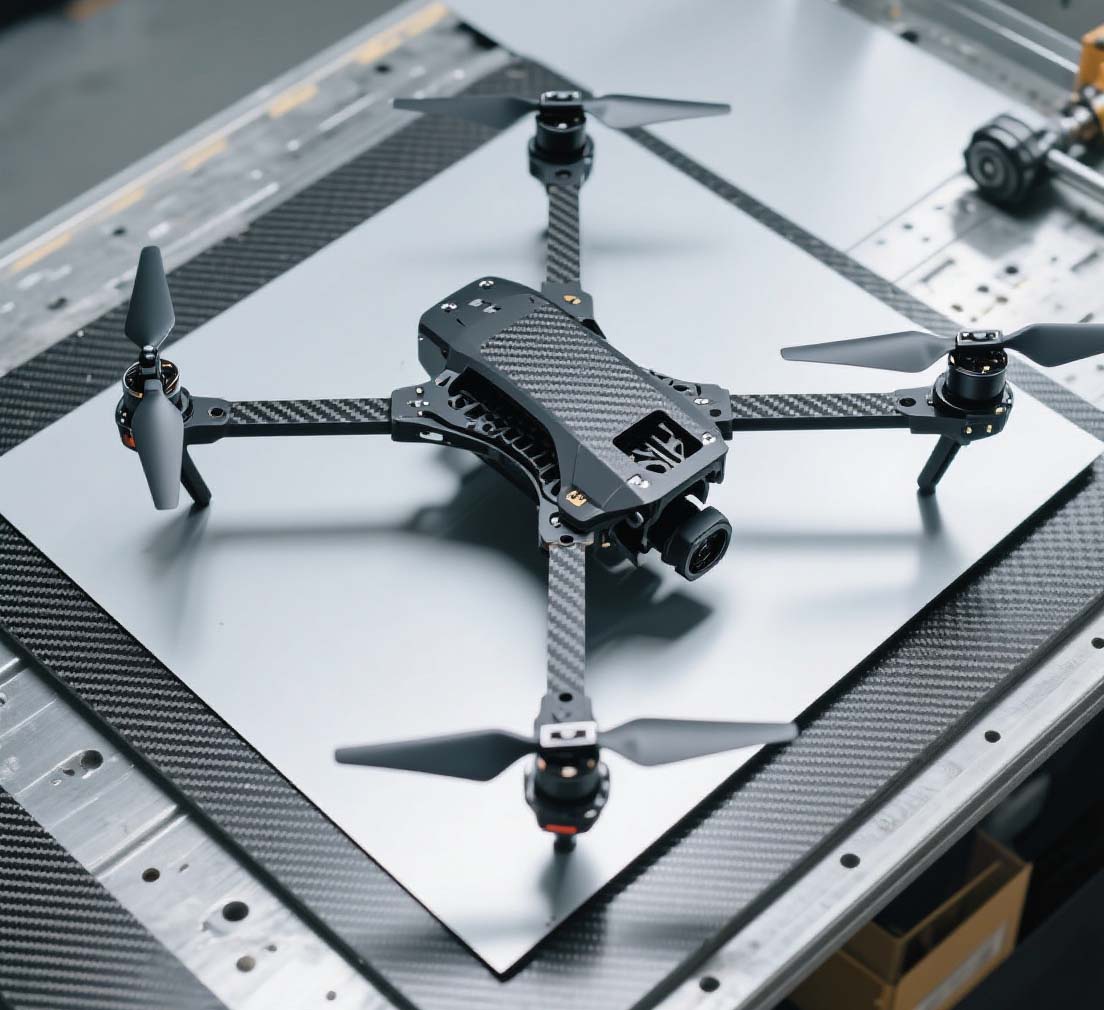
Performance gains from Fibre de carbone 4×8 manifest in multiple ways. Reduced weight translates to longer flight times and quicker acceleration. High stiffness prevents structural flex, improving flight stability and sensor accuracy. Moreover, uniform panels reduce the risk of weak points, which can be common in hand-assembled tubular frames. Overall, drones constructed with carbon fiber sheets can carry more sensors, cameras, or payloads while maintaining safety margins for extreme maneuvers.
Design Considerations and Engineering Trade-Offs
While Fibre de carbone 4×8 provides numerous benefits, drone engineers must consider trade-offs. Cutting and machining sheets require precision to avoid delamination, and the initial cost is higher than conventional materials like aluminum or plastic. Designers must also account for fiber orientation; improper layering can reduce structural performance. Despite these challenges, careful planning allows engineers to exploit sheet advantages without compromising durability.
Implementation Framework for Drone OEMs
Drone OEMs looking to integrate Fibre de carbone 4×8 should adopt a systematic approach:
Sélection des matériaux: Choose sheets with appropriate weave, resin system, and thickness based on drone size and payload.
Prototyping: Test small panels in stress-prone areas before committing to full-scale production.
Cutting & Machining: Use CNC routers or waterjet cutters for precise geometries, ensuring fiber edges remain intact.
Lamination & Bonding: Apply epoxy or specialized adhesives to join multiple sheets or integrate with other carbon fiber components.
Testing: Perform vibration, flex, and fatigue testing on panels to confirm design performance under real-world conditions.
Iterative Improvement: Refine thickness, layering, or orientation based on test outcomes to optimize flight efficiency.
Following this framework, drone manufacturers can confidently leverage Fibre de carbone 4×8 to produce lightweight, durable, and high-performing aircraft.
Conclusion
Carbon Fiber 4×8 Sheet empowers drone manufacturers to achieve structural efficiency without compromising performance. By replacing heavier materials and strategically layering sheets, OEMs can reduce weight, improve stability, and extend drone flight capabilities. Adopting carbon fiber sheets represents a smart investment in both performance and longevity, making them an essential material for modern drone design.