
 Portuguese
 English
 German
 Czech
 Spanish
 Hebrew
 French
 Danish
 Norwegian
 Dutch
Índice
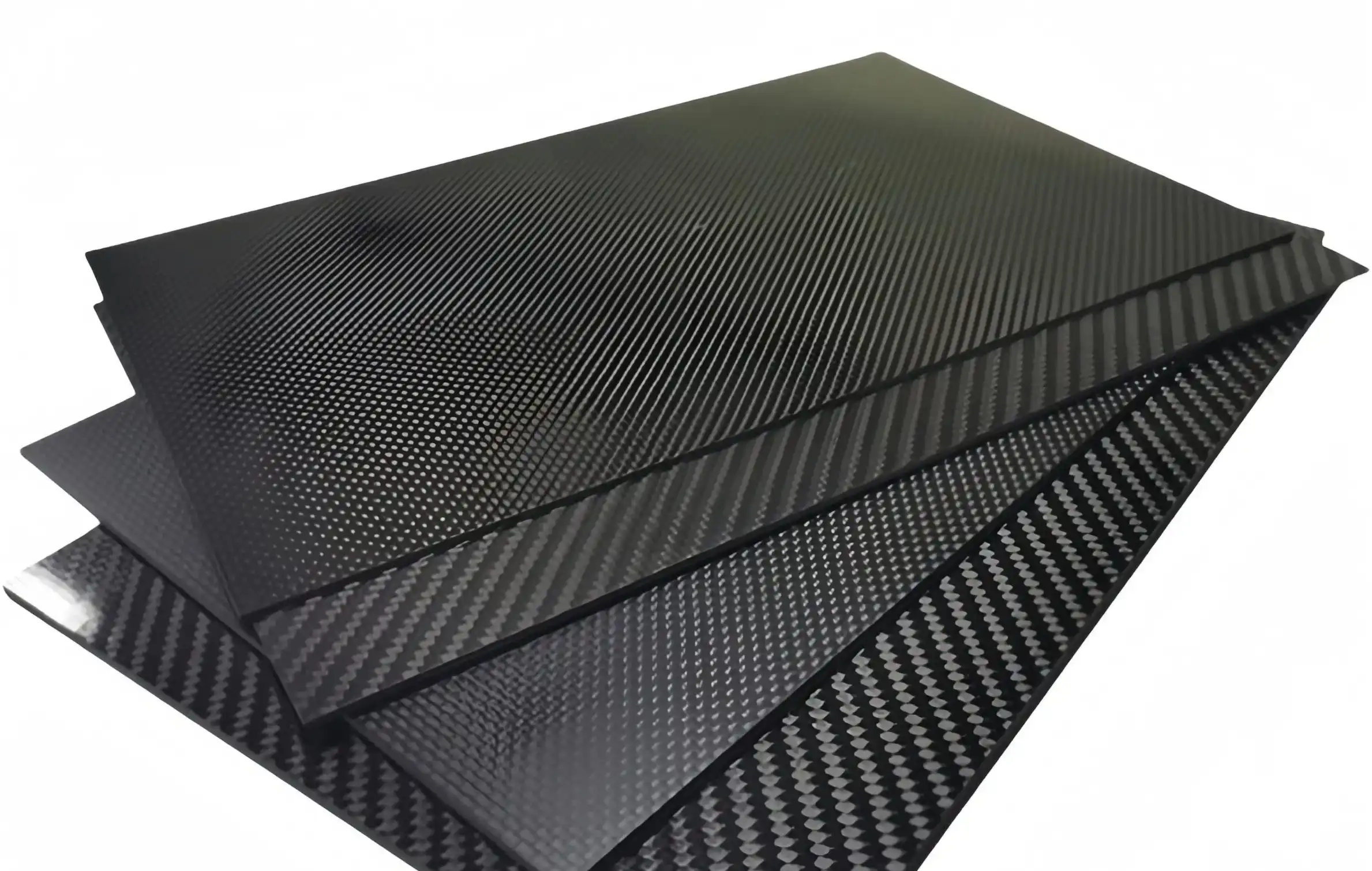
Uma chapa de CFRP pode parecer excelente ao sair da oficina e ainda assim causar problemas após um ano em equipamentos externos. A superfície perde brilho. As bordas ficam pálidas. Um furo de parafuso começa a mostrar uma linha escura ao seu redor.
A fibra de carbono raramente é a primeira parte a falhar. A superfície de resina, o revestimento, as bordas cortadas, os furos e as juntas coladas geralmente ficam mais expostos à luz solar e à água.
Para uso externo, chapas de CFRP precisam de mais do que um acabamento de carbono bonito. Elas precisam de um sistema de resina, proteção de bordas e revestimento superficial compatíveis com o ambiente real de instalação.
Por que a fibra de carbono não é a única parte que envelhece ao ar livre
A fibra de carbono em si é estável em muitas condições externas. A resina ao seu redor nem sempre é tão estável.
A resina epóxi pode amarelar, perder brilho, apresentar gizamento ou desenvolver microfissuras na superfície após longa exposição à luz solar. Essas mudanças podem começar como problemas estéticos. Com o tempo, podem expor o laminado e facilitar a entrada de umidade.
Um cliente pode ver um painel desbotar e presumir que a fibra de carbono falhou. Em muitos casos, o problema começa na superfície de resina ou no revestimento. A exposição aos raios UV pode causar mudanças fotoquímicas nos revestimentos epóxi, levando à descoloração, ao gizamento, ao surgimento de rachaduras e à perda de desempenho da superfície.
É por isso que “a fibra de carbono é resistente às intempéries” não é informação suficiente para um painel externo. O sistema completo de materiais é importante.
Artigos relacionados:
Como verificar o isolamento em tubos de barreira de fibra de vidro
Qual processo é melhor para um tubo de fibra de carbono de parede fina?
Folhas de Fibra de Carbono para Corte CNC: Guia de Defeitos de Borda
Como os compradores devem avaliar a MOQ e os custos unitários de estruturas de drone em fibra de carbono
Como avaliar o controle de qualidade para componentes de drones em fibra de carbono
Como verificar as dimensões de tubos de fibra de carbono para UAVs
Sistema de Resina e Acabamento Superficial: A Primeira Linha de Proteção Externa
Quando os compradores solicitam chapas de CFRP para equipamentos externos, eles devem descrever o ambiente de trabalho antes de escolher um acabamento.
Uma chapa usada em ambientes internos pode precisar apenas de uma superfície limpa e boa qualidade de usinagem. Uma chapa instalada em máquinas agrícolas, equipamentos marítimos, estruturas solares, invólucros de comunicação ou equipamentos de transporte enfrenta luz solar, chuva, umidade, sujeira e variações de temperatura.
Faça estas perguntas antes de fazer o pedido:
A chapa receberá luz solar direta?
Ela ficará exposta a névoa salina, lama, produtos químicos de limpeza ou água parada?
Qual é a faixa de temperatura de serviço esperada?
A superfície é visível, de suporte de carga ou ambas?
Por quanto tempo o acabamento deve permanecer apresentável?
Can the panel be repaired or recoated in service?
An epoxy-only surface can work in some protected applications. For long-term direct sunlight, a UV-resistant topcoat is usually the safer choice. Aliphatic polyurethane coatings generally retain color and gloss longer than epoxy-only systems under UV exposure.
Edges, Holes and Bonded Joints: Where Moisture Usually Enters
Outdoor failure often starts at the edge of a CFRP sheet, not in the middle.
A cut edge exposes the laminate layers. A drilled hole creates a new path for water. A scratch, chipped corner, or poorly sealed fastener can let moisture reach the resin and fiber interface. Once water enters, it may not remain at the surface.
Moisture can affect bonded joints as well. Water may enter along the bond line and weaken the interface between the adhesive and CFRP substrate. Research on CFRP bonded joints shows that moisture and heat can reduce joint strength over time, with damage often beginning near the edge of the bonded area.
For outdoor panels, protect the weak points:
Seal cut edges where possible
Deburr and coat drilled holes
Use washers and gaskets where fasteners pass through the sheet
Avoid leaving standing water around bolt heads
Design drainage paths so water does not collect in joints
Protect bonded areas with a compatible adhesive and edge sealing
A small edge-sealing detail can prevent a much larger repair later.
Choosing a Coating for CFRP Sheets Used Outdoors
A coating should match both the CFRP sheet and the service environment.
For a visible equipment panel, a UV-stable topcoat helps maintain color, gloss, and surface condition. For a hidden structural panel, the priority may be edge sealing, moisture resistance, and mechanical protection rather than appearance.
Common options include:
Clear protective coating over the carbon surface
Pigmented polyurethane topcoat
Epoxy primer with a UV-resistant topcoat
Protective film for transport and early service life
Local edge sealing around holes and cutouts
Do not assume that one coating suits every project. A panel near the sea may need more attention to salt exposure. A panel in a hot, sunny region may need stronger UV protection. A panel exposed to cleaning chemicals may need a different surface system.
The coating should cover the areas most likely to fail first: the face, back face, edges, drilled holes, and any bonded joint.
Testing CFRP Sheets for the Real Outdoor Environment
“Will it last outdoors?” is too broad a question for a supplier to answer accurately.
A better question is: What test conditions match the installation?
Accelerated weathering tests combine UV light, heat, and moisture to study how coatings and polymer materials respond to outdoor conditions. ASTM G154 uses fluorescent UV lamps with controlled UV and moisture cycles. ASTM G155 uses xenon arc lamps to reproduce a broader range of natural sunlight conditions.
Before testing, define:
The UV cycle and light source
Temperature and humidity conditions
Water spray or condensation exposure
Test duration
Properties to measure
Acceptance limits
Useful checks include color change, gloss loss, chalking, cracking, coating adhesion, edge condition, and mechanical strength after exposure.
Do not convert test hours directly into outdoor years. A 1,000-hour test does not automatically mean one year, five years, or ten years outdoors. The result depends on the resin, coating, UV spectrum, temperature, humidity, and the property being measured.
CFRP Sheets for Outdoor Use
Find answers about water resistance, UV exposure, outdoor coatings, edge sealing, and testing requirements for carbon fiber sheets.
01
Are CFRP sheets waterproof?
CFRP sheets resist water better than many unprotected materials, but they are not automatically maintenance-free outdoors. Water can enter through cut edges, drilled holes, scratches, and damaged coatings. Seal exposed edges and protect fastener areas for outdoor use.
02
Does carbon fiber fade in sunlight?
The carbon fiber itself is not usually the first part to fade. The resin and coating are more exposed to UV. An epoxy surface can yellow, lose gloss, chalk, or crack after outdoor exposure. Learn more about UV resistance of epoxy and polyurethane coatings.
03
Can I use an epoxy-only finish outdoors?
An epoxy-only finish may be acceptable for some protected applications, but it is not the best default for long-term direct sunlight. For outdoor equipment, an epoxy base system with a UV-resistant topcoat is often a more reliable choice. Compare epoxy and polyurethane UV resistance.
04
How should I protect cut edges and mounting holes?
Seal cut edges, coat drilled holes, and use gaskets or washers where fasteners pass through the sheet. These areas are common entry points for moisture. Good edge protection reduces the chance of water reaching the laminate or bond line. Read the related research.
05
How many UV test hours equal one year outdoors?
There is no universal conversion. The result depends on the resin, coating, UV spectrum, temperature, humidity, and test cycle. Define the test method, exposure duration, and acceptance criteria before testing.