
 Italian
  English
  German
  Japanese
  Arabic
  Czech
Czech  Spanish
  French
  Danish
  Polish
  Portuguese
  Norwegian
  Dutch
Dutch 
Indice dei contenuti
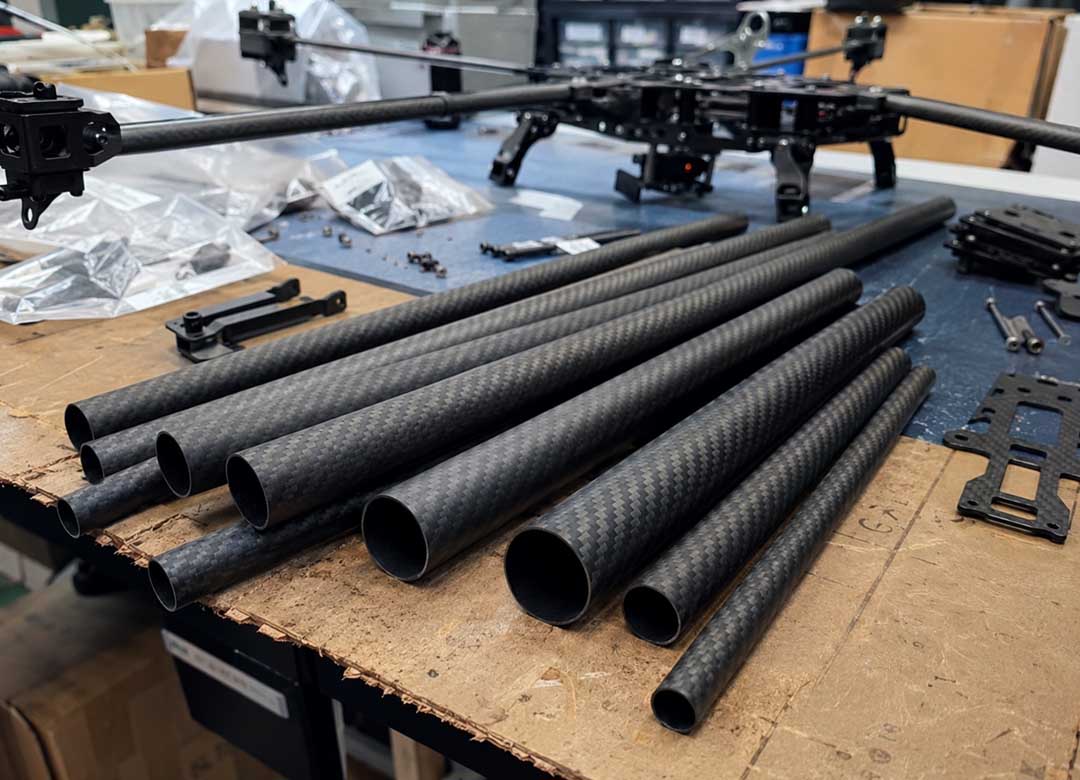
Aerospace prototype development rarely fails because one material is “bad.” More often, problems appear because the selected material does not match the structure, tooling method, cure process, or validation goal.
For engineers working under tight schedules, a wrong composite choice can delay testing, increase scrap, distort mold accuracy, or force a redesign after the first prototype has already been produced.
That is why experienced aerospace teams evaluate composite materials early, not after the part drawing is finished.
Why Carbon Fiber Fabrics Matter in Aerospace Prototype Development
Carbon Fiber Fabrics play a central role in aerospace prototype development because they influence weight, stiffness, manufacturability, surface quality, and test reliability at the same time.Aerospace teams usually evaluate fabrics more carefully than automotive or sporting goods manufacturers because prototype parts may support aerodynamic testing, assembly trials, load validation, or early flight-related studies.
A small material mistake can produce misleading results and cause unnecessary redesign work.For example, 3K Carbon Fiber Fabric is often chosen for thin laminates, lightweight panels, or visible surfaces where fine texture and controlled thickness matter.6K Carbon Fiber Fabric can be more efficient for larger structures because it builds thickness faster and may reduce layup time.
However, heavier tow size is not automatically better. Engineers must consider drape, fiber alignment, laminate schedule, resin content, and weight targets.In aerospace Composite Materials selection, the fabric must support both the design intent and the manufacturing reality.
Articoli correlati:
How to Request a Quote for a Single Custom Carbon Fiber Tube
Carbon Fiber Production: What Buyers Should Know Before Choosing
Raccordi per tubi in fibra di carbonio: come scegliere il tipo giusto
Un fornitore di tubi in fibra di carbonio è in grado di rispettare il vostro programma di laminazione personalizzato?
Produttore di grandi lastre in fibra di carbonio | Pannelli su misura
Tubi in fibra di carbonio avvolti su bobina: 5 vantaggi chiave rispetto ai tubi pultrusi
Choosing Between Plain Weave Carbon Fiber and Twill Weave Carbon Fiber
Fibra di carbonio a trama semplice e Fibra di carbonio a trama ritorta are both widely used in aerospace composite projects, but they behave differently during layup.
Plain weave offers good dimensional stability and is easier to control on flat or moderately curved surfaces. It can help technicians maintain fiber orientation and reduce distortion during cutting, handling, and placement. The limitation is that plain weave may not conform well to deep curves, tight radii, or complex mold geometry.
Twill weave usually provides better drapability, making it useful for aerospace fairings, ducts, access covers, UAV shells, and other parts with compound curves. A common engineering mistake is selecting the weave based only on appearance.
Surface finish matters in aerospace, especially for visible or aerodynamic components, but manufacturability matters just as much. Poor weave selection can cause bridging, wrinkling, fiber distortion, resin-rich areas, and inconsistent laminate thickness. The best choice depends on geometry, inspection standards, layup sequence, and production efficiency.
How Carbon Prepreg Improves Consistency in Aerospace Composite Materials
Carbon Prepreg is often preferred in aerospace prototype programs because it gives engineers better control over resin content, fiber volume fraction, mechanical performance, and repeatability. During early-stage validation, consistency is extremely important.
If one prototype part passes a stiffness test and the next part fails because of resin variation, the engineering team may waste time investigating the design instead of the process. Compared with wet layup, Carbon Prepreg reduces operator-dependent variation and supports cleaner, more predictable laminate construction. This is especially valuable when aerospace Composite Materials must meet weight limits, strength requirements, and dimensional expectations at the same time.
Prepreg systems also make documentation easier because the material format, resin system, out-time, and cure cycle can be controlled more precisely. The tradeoff is that prepreg requires proper storage, handling discipline, vacuum bagging knowledge, and compatible tooling. When used correctly, it helps prototype teams generate test results that are more meaningful and easier to repeat.
Why Tooling Prepreg Plays a Critical Role in Aerospace Mold Manufacturing
Tooling Prepreg is critical in aerospace mold manufacturing because prototype quality depends heavily on tool stability. Even when CNC mold fabrication produces an accurate master or mold surface, the tool must remain stable through heat, vacuum pressure, cure cycles, demolding, and repeated use.
Poor tooling materials can create serious problems, including dimensional drift, surface print-through, vacuum leaks, uneven thermal expansion, and premature tool wear. These issues are expensive because they affect every part made from the mold. In aerospace development, a distorted tool can make engineers question whether a failed prototype comes from the design, the laminate, or the mold itself. That uncertainty slows decision-making and increases validation cost.
Tooling Prepreg helps manufacturers build composite tools with improved thermal stability, better surface quality, and longer tool life. It is especially useful when prototype parts require tight tolerances, repeatable assembly fit, or elevated-temperature curing. Good tooling choices protect the entire development schedule.
When Aerospace Engineers Choose Aramid Fiber and Kevlar Fabric Solutions
Aramid Fiber and Kevlar Fabric are selected when aerospace engineers need impact resistance, toughness, abrasion resistance, or energy absorption rather than maximum stiffness alone.
Fibra di carbonio performs extremely well in stiffness-to-weight applications, but it can be brittle under certain impact conditions. Kevlar Fabric often performs better in protective structures, interior panels, access covers, radomes, cargo-area parts, and components exposed to repeated handling or potential damage. It is also common to use aramid in hybrid composite structures, where carbon fiber provides stiffness and Kevlar improves toughness or damage tolerance. This approach helps solve customer challenges that cannot be addressed by one material alone.
However, aramid also has tradeoffs. It can be more difficult to cut, machine, sand, and finish cleanly, and it does not offer the same compressive stiffness as carbon fiber. Experienced composite manufacturers help aerospace customers decide where Kevlar adds value and where carbon fiber remains the better structural option.
Summary
Successful aerospace prototype projects depend on selecting suitable composite materials early in development. Material decisions should be based on structure, tooling, cure process, weight targets, surface requirements, and validation goals, not only on datasheet values.
Experienced composite suppliers can help customers evaluate Carbon Fiber Fabrics, Carbon Prepreg, Tooling Prepreg, Aramid Fiber, Kevlar Fabric, and other Composite Materials according to actual engineering requirements, reducing delays and improving prototype reliability.