
 Danish
 English
 German
 Czech
 Spanish
 Hebrew
 French
 Portuguese
 Norwegian
 Dutch
Indholdsfortegnelse
Rulleviklet vs. filamentviklet: Procesforskelle
Relaterede artikler:
Hvilken proces er bedre til et tyndvægget kulfiberrør?
Kulfiberplader til CNC-skæring: Vejledning i kantfejl
Hvordan bør købere vurdere MOQ og enhedsomkostninger for carbonfiberrammer til droner
How to Evaluate Quality Control for Carbon Fiber Drone Components
Sådan verificerer du dimensioner af kulfiberrør til UAV'er
CFRP-plader til udendørsudstyr: UV, fugt og langvarig vejrpåvirkning
Styrke og opbygning af tyndvægget kulfiberrør
Styrke bør altid diskuteres i forhold til det faktiske belastningstilfælde. Et rør, der anvendes til ringe til motorrotorhuse, kan kræve betydelig omkredsforstærkning for at modstå periferiske belastninger, men et design med kun omkredsforstærkning er sjældent det fuldstændige svar.
Aksial forstærkning
En vis aksial forstærkning kan understøtte aksial stabilitet og forbedre rørets anvendelighed under håndtering, skæring og samling.
Bøjnings- og torsionsbelastninger
Hvis applikationen også involverer bøjning eller torsion, kan yderligere fiberorienteringer være nødvendige. Mere omkredsmateriale kompenserer ikke automatisk for utilstrækkelig forstærkning i andre retninger.
Rulleindpakning
Rullevikling gør det muligt at arrangere individuelle præpreg-plader i en skræddersyet sekvens.
Vikling af filament
Filamentvikling kan effektivt placere kontinuerlige fibre ved specificerede viklingsvinkler, herunder mønstre tæt på omkredsretningen.
Kvalitet af det færdige laminat
I begge tilfælde afhænger den endelige ydeevne af mere end fibervinklen. Fibervolumenfraktion, harpiksfordeling, hulrumsindhold, interlaminar binding, hærdning og ensartethed i vægtykkelsen påvirker alle det færdige laminat.
Købere bør derfor beskrive applikationen og belastningsforholdene i stedet for at anmode om en bestemt proces udelukkende, fordi den antages at være stærkere.
Thin Wall Carbon Fiber Tube Tolerance and Finish
Large Diameter, Thin Walls: Why Process Selection Matters
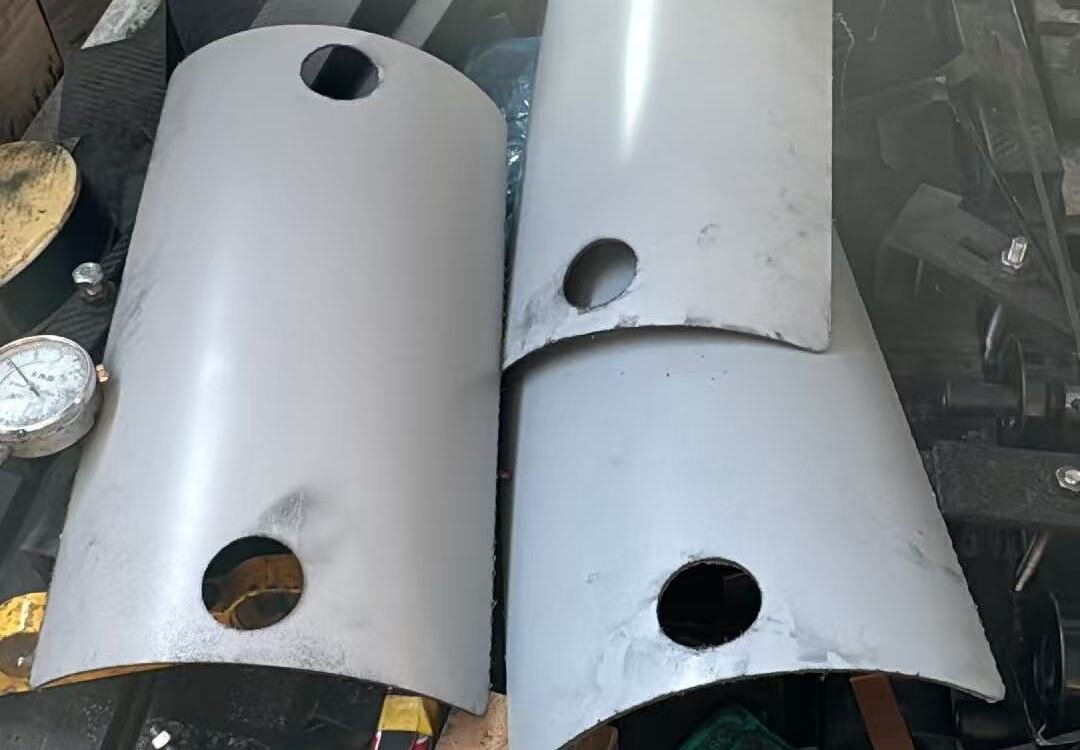
Large diameter and thin wall construction create a more demanding manufacturing and handling combination. A tube with an inner diameter of 197 mm and a wall thickness of only 2 mm has less sectional depth available to resist local distortion than a smaller or thicker-walled tube.
Manufacturing and Handling Control
This makes consolidation, curing, demolding, storage, and packaging particularly important.
Diameter, Ovality, and Local Variation
The manufacturer must control not only the average diameter but also ovality and local variation.
Ring Cutting and Machining
Cutting the tube into rings introduces additional considerations because the subsequent clamping and machining operations can apply localized forces.
Epoxy System and Cure Schedule
Thermal requirements also belong in the process discussion. If the tube must use an epoxy system with a Tg of at least 120°C, the resin and cure schedule should be confirmed through appropriate supplier documentation.
Documented Tg Value and Test Basis
A generic description such as “high-temperature epoxy” is not a substitute for an actual Tg value and its test basis.
For an operating temperature of approximately 90°C, buyers should still evaluate the complete motor environment and verify the material requirements for their specific design rather than relying on the temperature comparison alone.
How to Choose a Thin Wall Carbon Fiber Tube
- Critical inner and outer dimensions, including tolerances
- Wall thickness, length, roundness, and straightness requirements
- Hoop, axial, bending, and torsional loading conditions
- Operating temperature and required resin Tg
- Inner and outer surface requirements
- Details of subsequent cutting, bonding, or assembly
- Prototype quantity and expected future demand
Custom Prototypes: Comparing Setup, Flexibility, and Cost
Sådan vælger du den rigtige leverandør af kulfiberrør til dit projekt
If you are comparing carbon fiber suppliers and noticing unexpected price or performance differences, it is worth taking a closer look at how each manufacturer manages its production process. A brief technical discussion early on can often reveal risks that are not visible in a quotation.
The engineering team at CarbonCore Dynamik is available to review your drawings, materials, and performance requirements before production begins—helping you avoid costly revisions and ensuring the final product meets real-world demands.