
 English
 German
 Czech
 Spanish
 Hebrew
 French
 Danish
 Portuguese
 Norwegian
 Dutch
Table of Contents
Roll-Wrapped vs. Filament-Wound: Process Differences
Related articles:
Which Process Is Better for a Thin Wall Carbon Fiber Tube?
Carbon Fiber Sheets for CNC Cutting: Edge Defects Guide
How Should Buyers Evaluate MOQ and Unit Costs for Carbon Fiber Drone Frames
How to Evaluate Quality Control for Carbon Fiber Drone Components
How to Verify Dimensions of Carbon Fiber Tubes for UAVs
CFRP Sheets for Outdoor Equipment: UV, Moisture and Long-Term Weathering
Thin Wall Carbon Fiber Tube Strength and Layup
Strength should always be discussed in relation to the actual load case. A tube used for motor rotor housing rings may require substantial hoop reinforcement to resist circumferential loads, but a hoop-only design is rarely the complete answer.
Axial Reinforcement
Some axial reinforcement can support axial stability and improve the tube’s usefulness during handling, cutting, and assembly.
Bending and Torsional Loads
If the application also involves bending or torsion, additional fiber orientations may be necessary. More hoop material does not automatically compensate for insufficient reinforcement in other directions.
Roll Wrapping
Roll wrapping allows individual prepreg plies to be arranged in a tailored sequence.
Filament Winding
Filament winding can place continuous fibers efficiently at specified winding angles, including near-hoop patterns.
Finished Laminate Quality
In either case, final performance depends on more than fiber angle. Fiber volume fraction, resin distribution, void content, interlaminar bonding, curing, and wall-thickness consistency all influence the finished laminate.
Buyers should therefore describe the application and loading conditions instead of requesting a particular process solely because it is assumed to be stronger.
Thin Wall Carbon Fiber Tube Tolerance and Finish
Large Diameter, Thin Walls: Why Process Selection Matters
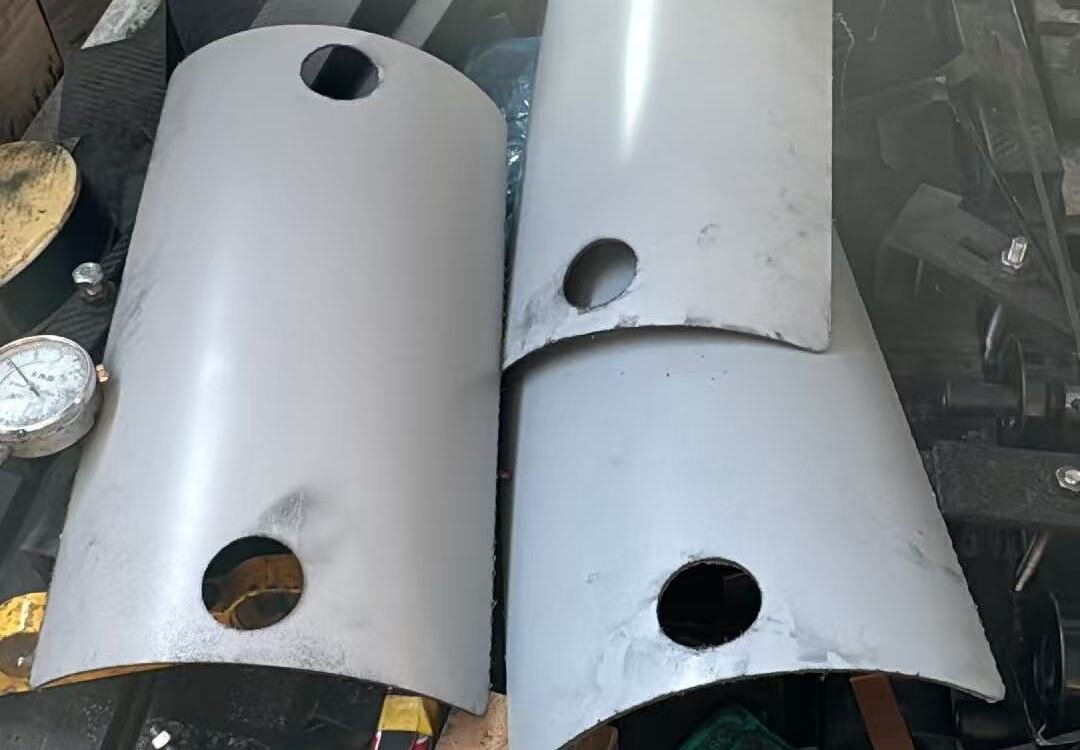
Large diameter and thin wall construction create a more demanding manufacturing and handling combination. A tube with an inner diameter of 197 mm and a wall thickness of only 2 mm has less sectional depth available to resist local distortion than a smaller or thicker-walled tube.
Manufacturing and Handling Control
This makes consolidation, curing, demolding, storage, and packaging particularly important.
Diameter, Ovality, and Local Variation
The manufacturer must control not only the average diameter but also ovality and local variation.
Ring Cutting and Machining
Cutting the tube into rings introduces additional considerations because the subsequent clamping and machining operations can apply localized forces.
Epoxy System and Cure Schedule
Thermal requirements also belong in the process discussion. If the tube must use an epoxy system with a Tg of at least 120°C, the resin and cure schedule should be confirmed through appropriate supplier documentation.
Documented Tg Value and Test Basis
A generic description such as “high-temperature epoxy” is not a substitute for an actual Tg value and its test basis.
For an operating temperature of approximately 90°C, buyers should still evaluate the complete motor environment and verify the material requirements for their specific design rather than relying on the temperature comparison alone.
How to Choose a Thin Wall Carbon Fiber Tube
- Critical inner and outer dimensions, including tolerances
- Wall thickness, length, roundness, and straightness requirements
- Hoop, axial, bending, and torsional loading conditions
- Operating temperature and required resin Tg
- Inner and outer surface requirements
- Details of subsequent cutting, bonding, or assembly
- Prototype quantity and expected future demand
Custom Prototypes: Comparing Setup, Flexibility, and Cost
Choosing the Right Carbon Fiber Tube Supplier For Your Project
If you are comparing carbon fiber suppliers and noticing unexpected price or performance differences, it is worth taking a closer look at how each manufacturer manages its production process. A brief technical discussion early on can often reveal risks that are not visible in a quotation.
The engineering team at CarbonCore Dynamics is available to review your drawings, materials, and performance requirements before production begins—helping you avoid costly revisions and ensuring the final product meets real-world demands.